Rong-Gong Lin II laments that what with the warm ocean waters, Southern California has lost its traditional ‘Mediterranean’ climate. On the contrary, what we are experiencing is the ‘Mediterranean’ climate of the ACTUAL Mediterranean!
In a ‘Mediterranean’ climate, the summer or higher sun months get relatively little rain, while in the winter or lower sun months they get a lot more precipitation. There are large belts north of the Tropic of Cancer and south of the Tropic of Capricorn called the ‘horse latitudes’, where there is very little rain. These belts give us many of the great deserts of the world. They also shift northward or southward with the sun. So, on the north side of these desert belts, there are stretches that are ‘deserts’ when the sun is to the north, but rainier when the sun is in the south. Meanwhile, on the south side of the desert belts, there are areas that join the ‘desert’ when the sun is in the south but receive more rain when the sun is in the north.
The Mediterranean region lies north of the Sahara, while to the south lies a corresponding belt called the Sahel. The Mediterranean is included in the ‘Sahara’ when the sun is further north and falls into the rain belt when the sun is in the south. The Sahel, then, gets some rain when the Mediterranean is relatively dry, and vice versa; it is in the dry season when the Mediterranean is most wet. The climate that has its dry season at the opposite time of year to the Mediterranean zones is usually called ‘savanna’.
But what is different about the ‘Mediterranean’ climate of the actual Mediterranean Sea region from the other ‘Mediterranean’ enclaves around the world; California, Central Chile, South Africa’s Western Cape, and Australia’s Perth and Adelaide enclaves?
The Mediterranean is a large body of water running mostly east-west precisely in the stretch of latitude where, as we mentioned, rain should fall mostly in winter. It is a relatively warm body of water and is connected to the larger ocean only at the Strait of Gibraltar. Consequently, while there may not be a lot of actual rain during the summer months, the humidity is not particularly low. Beirut and Tel Aviv, in the summer, have the rainfall of Los Angeles at the same time of year, but their humidity is closer to that of Miami! And the Red Sea and Persian Gulf are even worse! To behold the desert landscapes that surround them should not deceive us in to thinking we’ll get ‘dry heat’ on their shores.
Another unique feature of the actual Mediterranean as opposed to other Mediterranean climates is that, because the water is so much warmer normally, early fall weather fronts hitting the Mediterranean bring early rains. In many parts of the northern Mediterranean, October and November may actually be rainier than January and February! Let’s see whether the El Niño and the Kelvin wave make Southern California rainier this year in October and November!
But what about all the other Mediterranean zones of the world? Oceans rotate clockwise in the Northern Hemisphere and counterclockwise in the Southern Hemisphere. For that reason, all the other Mediterranean climates of the world are located on the west coasts of continents, and they have, off their shores, cooler currents. This means the coastal air is set with a low dew point, and so the climate it produces tends to be coolish and overcast. As the air moves inland over land, the temperature of the air heats up but the dew point does not, and the widening gap between the dew point and the air temperature provides what’s often called ‘dry heat’.
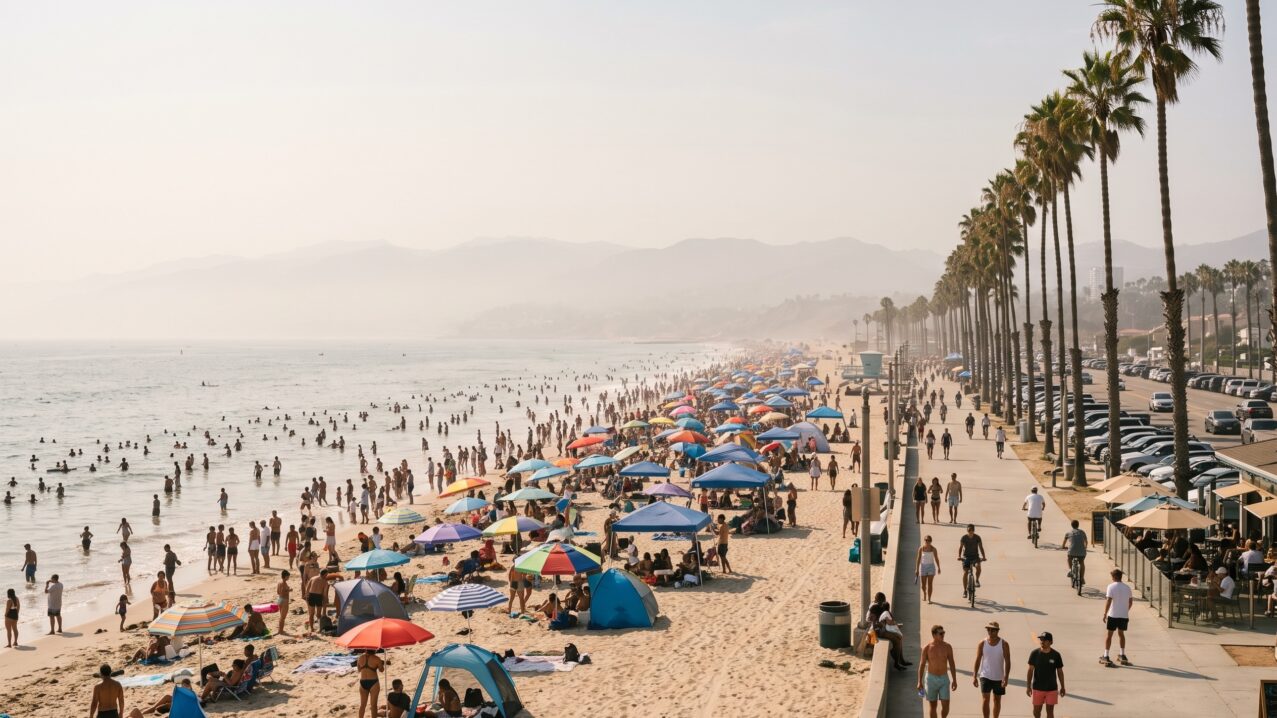
The Mediterranean world, Portugal and Morocco, and a small bit of Spain, actually face the open Atlantic and experience relatively cool weather conditions, as we know in California. The rest of the Mediterranean does not. This past summer a heat wave in the waters of the Eastern Pacific pushed up the dew point and gave us unprecedented levels of humidity. Yes, that means it’s steamy and uncomfortable, yes. It is unprecedented, certainly. I fear it’s more real and actually Mediterranean than any climate we’ve ever known!