The South may be the one part of the country where ‘evangelicals’ actually have some cultural dominance. But ‘evangelicalism’ has had its power centers all around the country. This is especially so in the Philadelphia-Princeton belt, the halo around Lake Michigan, and even Southern California, of all places!
People like to blame the South for all the evils they associate with ‘evangelicalism’, MAGA, and other such things. And Trump’s followers have not always helped – running around displaying Confederate flags in Michigan. What are they thinking? It’s almost as if they thought we were trying to refight the Civil War. [The Civil War did not end in 1865, apparently. It never seems to end.]
Admittedly, Randall Balmer, the excellent apostate scholar, is right when he says it was not Roe vs. Wade, initially, that provoked a culture war. Instead, it was the ruling by the IRS under Carter that new private Christian schools were ‘guilty until proven innocent’ of being segregation academies. There have been ‘segregation academies’, of course, but after the cultural changes of the 1960s, there might have been other reasons to want a ‘Christian school’. [Some intellectual conservatives, of course, had been criticizing the environmental determinism and ‘democratism’ of John Dewey for a long time. I agree that John Dewey was an evil man.]
Before that time, the particular groups that had been major advocates of ‘Christian schools’ had been the Catholics and what I’ll call the ‘Continental Protestants’ – the Lutherans, and those Reformed of Continental origin, mainly the Dutch. These were the primary groups in the North, by the way, that supported Jacksonian Democracy rather than the American Whig Party.
Meanwhile, ‘Island Protestants’, those who traced their ancestry to Great Britain or Ireland, thought otherwise. They thought that community-controlled government schools were fine. Indeed, in some parts of the country [it was never as universal as ‘prayers in public school’ propagandists suggest] there were Bible readings and recitations of the Pater Noster and other devotions in the government schools.
[It is noteworthy that one of the reasons many Catholics supported Catholic schools is that they disapproved of the King James Version of the Bible, preferring their Douay Bible with six extra books in it.] By the time the Supreme Court decisions came down in the early 1960s, the devotions had been pretty much reduced to a mere Theism, as ‘Judeo-Christianity’ – whatever that is – became a national icon.
‘Christian nationalists’ look back at New England as having established our ‘national covenant’. I’m not sure I like the idea of New England speaking for the whole country, although New Englanders have, for a long time, tried to do just that! The last two states to give up a formally established state church [which the First Amendment does allow them to have, although I think it’s a bad idea] were Connecticut and Massachusetts. And I don’t believe that anyone thinks of these two states as ‘buckles of the Bible Belt’ in our own time! But one church, Park Street in the early 19th century, stayed faithful, and while its denomination, the Conservative Congregational Christian Conference or ‘4Cs’, is not large, Lake Avenue in Pasadena can be safely called the western sister of Park Street.
In the first half of the 20th century, Boston moral censorship was notorious. In fact, I think some authors contrived to be ‘banned in Boston’ so that they might get more sales elsewhere! Nowadays the only thing, as far as I can tell, that is ‘banned in Boston’ is any remark that is a slur against any of ‘the groups’.
But the old New England spirit survives in another place. New England may have apostatized into Unitarianism and Transcendentalism, but the old heritage is carried on by another heresy: Mormonism. While Southern culture has become the working class culture of most of the nation, the Mormons are the least influenced by it, and they are the most Trump-skeptical of the ‘conservative’ religious traditions. They are way off regarding orthodoxy of doctrine, but they are more successful regarding what Francis Schaeffer called ‘orthodoxy of community’ than most orthodox Christians. I sometimes think that if Jesus had composed the Parable of the Good Samaritan today, He might have called it the ‘Good Mormon’!
Most of the Fundamentalist-Modernist battles were fought in the North. We know about the events in the Philadelphia-Princeton area about a century ago. In fact, 97 years ago this year, a number of Princeton theologians seceded to Philadelphia and established Westminster Seminary in Philadelphia. Princeton had been the intellectual center of American Protestantism, at least on the more Reformed side; such names as Warfield and Hodge are well known. It was through Princeton, the hinge of classical Protestantism in the U S, that the formerly rather Godless, or at least nominal, Southern United States became ‘the Bible Belt’. And, independently of that, I have read Princeton being described as ‘the North’s only Southern campus’ in its design and culture.
But the center of the ‘Evangelical Establishment’ is, as everyone really knows, a halo around Lake Michigan. Wheaton and Moody, and the late Trinity Evangelical Divinity School and Trinity International University, are in Metropolitan Chicago. Billy Sunday based himself there; he was born no further south than Ames, Iowa. [I often wonder if he might have found a different calling if he had been named Billy Tuesday, but Sunday was his real last name – it was originally Sonntag, not an uncommon German surname.] Billy Graham was, of course, a Southerner, but his organizational headquarters is in Minneapolis, which I suppose is stretching the ‘halo around Lake Michigan’ a bit. Well, doesn’t Inter-Varsity have its headquarters in Madison, Wisconsin?
And then, of course, there’s Grand Rapids, Michigan. It’s known as the ‘Jerusalem of the Midwest’. I have been there many times, and grits and barbecue are not on the menu! It was and is the center of the Dutch classical Protestant intellectual tradition. There is Calvin University, Cornerstone University, Grace Christian University, and the publishing houses of Zondervan, Baker, Eerdmans, Kregel, and Tyndale! Not to mention the De Vos and Cornerstone charitable foundations.
The Dutch have provided, in fact, much of the intellectual leadership, far out of proportion to their numbers, of classical ‘evangelical’ Protestantism in North America. This dates back to Abraham Kuyper, of course, who seems to have more influence here these days than in his native land! [Someone will say, “Isn’t ‘evangelical intellectual’ kind of an oxymoron?” and I would have to say, “Largely, yes, but the Dutch Americans are the main exception.”]
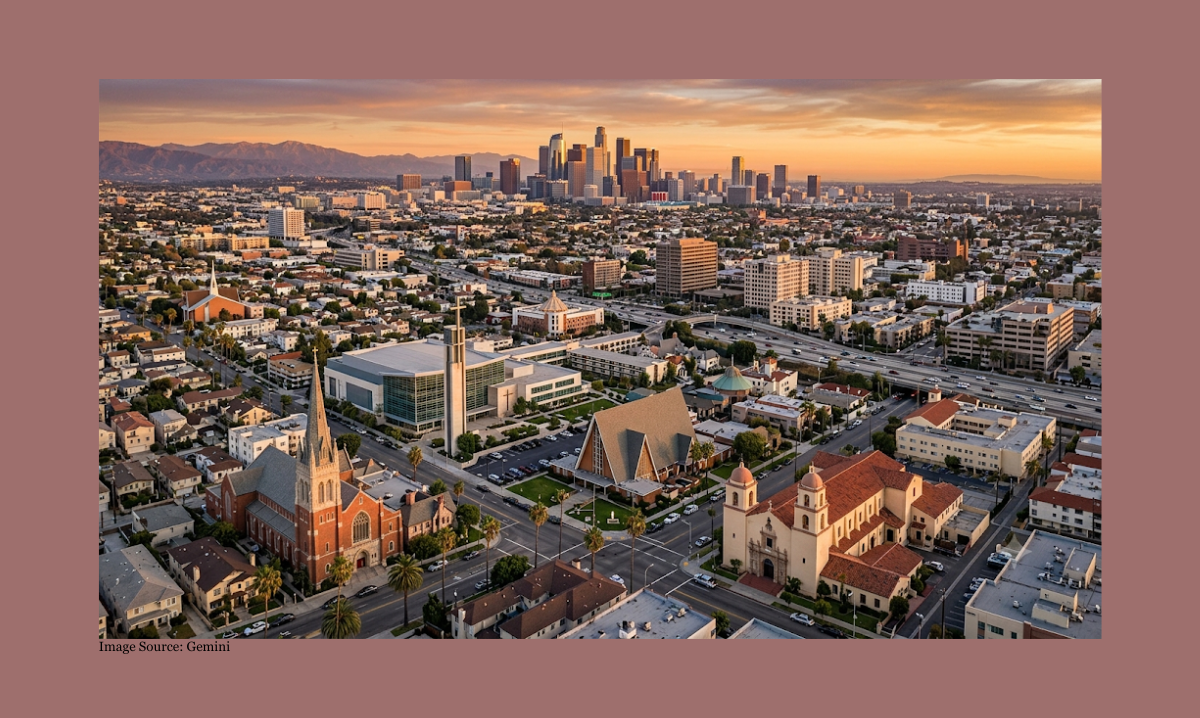
Southern California is thought of as a land of godless hedonism, but Christianity has been stronger there than any other part of the West Coast. So have a number of other religions, especially Hindu-ish cults. The Self-Realization Fellowship, founded by Paramahansa Yogananda, was once practically a mainline denomination. [Of course, until I started reading about orthodox theology in my twenties, I thought the Church of Christ, Scientist, was a mainline denomination!]. When the Self-Realization Fellowship opened its huge Lake Shrine in Pacific Palisades in 1950, the keynote speaker was no less than Lieutenant Governor [later Governor] of the State of California, Goodwin Knight. Ask me why I might not be an enthusiast for ‘prayer in public schools’ in California.
The Pentecostal movement got its start in Los Angeles, in 1906, in a short alley called Azusa Street in an area now called, oddly enough, Little Tokyo. It has now become the majority form of Protestantism [assuming it is Protestant, which can be debated] in much of the world. It started as a mixed racial movement, but soon spun off two denominations; Church of God in Christ, for the blacks, and Assemblies of God, for the whites. Later, Aimee Semple McPherson entertained the city with her methods; she was not from the South, but from Ontario, Canada; and the denomination she started, Foursquare Gospel, still exists.
‘Fighting Bob’ Shuler was actually from the South, from the state of Virginia. He was a Southern Methodist radio pastor, yet completely unlike a more recent ‘celebrity pastor’ in California with a very similar name! He preached regularly against all kinds of vice and corruption in Los Angeles, and ran for office on the Prohibitionist ticket.
I might mention here James Fifield, of First Congregational Church a little west of MacArthur Park, who did much to establish Christian economic Libertarianism as well as an early form of Christian Nationalism. He was not, by the way, considered a ‘fundamentalist’, and a case can be made that Christian Nationalism did not get its start in fundamentalism, but in the mainline! Today, First Congregational, if you look up its website, is happily ‘diverse’ and ‘affirming’, like any good UCC [Unitarians Calling themselves Christians] church. [Meanwhile the whole thesis that Christian Nationalism is of mainline, not fundamentalist, origin is beyond my capacity to research.]
Bill Bright, who established Campus Crusade for Christ [now Cru], actually was from Oklahoma, which is sort of ‘the South’, but made his empire in California after being discipled by Henrietta Mears, a native of Fargo, North Dakota.
Two more recent major world denominations came out of Orange County, California, during the height of the Jesus movement. [Mr. Ryan Burge, if you don’t think Calvary Chapel and the Vineyard are denominations, shame on you!]
Chuck Smith, founder of Calvary Chapel, was a native Californian who grew up in the Foursquare denomination. John Wimber was from Missouri, which people argue over whether it’s ‘Southern’ or not, or just the only former slave state in the Midwest, but he was born fairly close to the Iowa line. So his Southern status is rather dubious. He also made his career in California, being the manager of the Righteous Brothers, the famous ‘blue-eyed soul’ group. [Orange County being rather short on real black people, ‘blue eyed soul’ was the best we could do in that genre.]
Do not imagine that the Jesus movement was confined to California, though; the most well-known Jesus People commune is in Chicago, in the Lake Michigan halo.
John MacArthur, who grew one of Los Angeles County’s major megachurches, was a native of Los Angeles. A second megachurch in the county is West Angeles Church of God in Christ, which is black. Another important one is Lake Avenue, which, as I’ve said, is the western sister church of Boston’s Park Street.
Even on the rest of the West Coast, a remnant returns. Silicon Valley had its Peninsula Bible church in the 1970s, that initially planted Orange County’s Mariners Church. The reigning church in Silicon Valley now is supposed to be Menlo Church. Portland had Multnomah University and still has Western Seminary and Luis Palau’s headquarters, and Earl Palmer was a popular pastor in both Seattle and Berkeley in the early 1970s. But ‘remnant’ is the word; the coastal Northwest is called by religion scholars the ‘None Zone’ because so many would prefer to worship God’s creation rather than God. I like to think of the area west of the Cascades as ‘Little Europe’ because their religious attitudes are quite European. Also, the climate zone is very similar to the climate of most of Northwestern Europe!
So, with all this in mind, we can conclude that orthodox Protestantism [which I used to call ‘evangelicalism’ before that word got politicized], and orthodox Christianity as a whole, is hardly confined to the South. It is not even fair to call it a phenomenon of ‘red states’. Even in the South, much of the culture is more or less post-Christian these days. But to quote one of my favorite verses from Isaiah, “a remnant shall return” (Isaiah 10:21). America as a whole won’t be saved, but a remnant always returns to the Gospel.