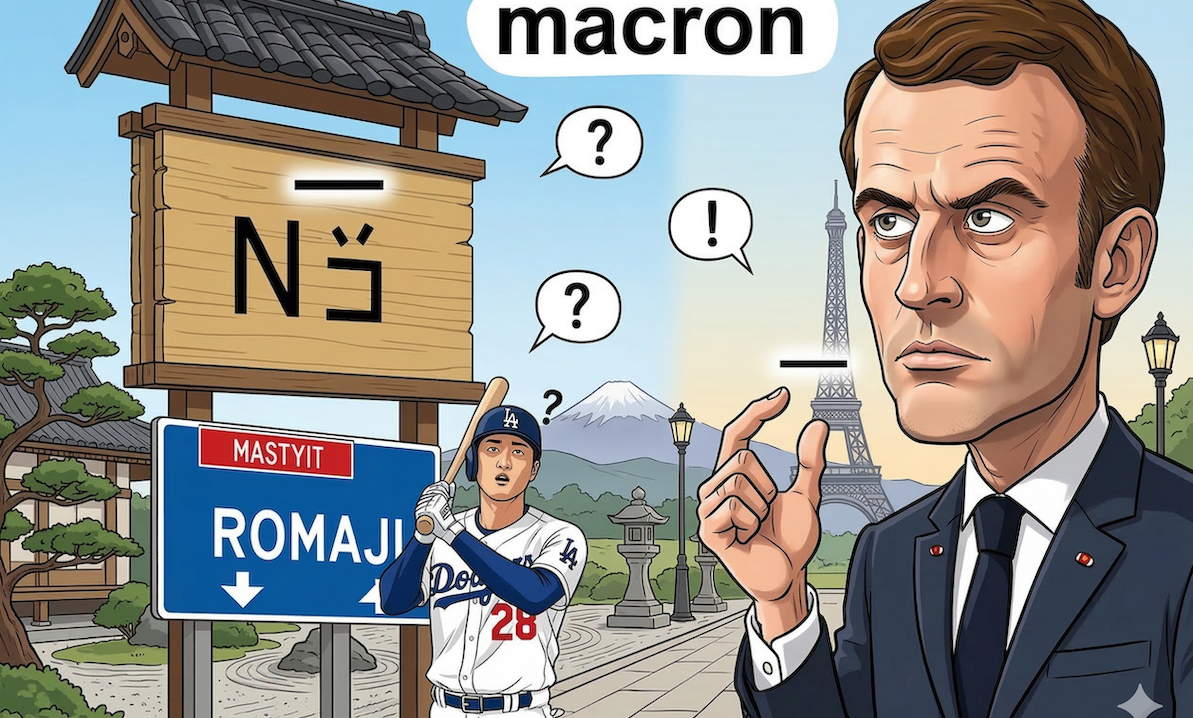
A difficult feature of the current – and most popular method – of romanizing Japanese makes it difficult to pronounce properly or understand some words. Would you prefer a Nô play, a Noh play, a Nou play, or a Noo play?
There is one particular diacritical mark in Romanized Japanese that can particularly lead to much confusion. It is called a macron, and like most such marks, it is often omitted or dropped. A macron is a short horizontal line over a letter, or a French politician. French itself does not use it. French does use an accent tilting forward, an accent tilting backward, or an accent that looks like a hat. Only the French understand what they mean. I was recently in Japan, and I can testify that it is often missing from the romaji (roumaji, rohmaji, or romaji) texts on highway signs. It indicates that the vowel in question takes up two Japanese syllables instead of one. The macron is now used in writing Hawaiian, Maori, and related languages.
A star player in the recent World Series, in which Los Angeles defeated Toronto, is a player of Japanese origin who spells his name Shohei Ohtani. That’s one solution, but if we are going to be consistent with the use of the ‘h’ it should be ‘Shohhei Ohtani’ from the northeast of the island of ‘Honshuh’; I throw the island in, because the ‘h’ is not uncommon after ‘o’. I have not seen ‘uh’ very often. If we settle on the ‘h’ we must use it consistently!
There now is a modified version of Hepburn used in the schoolbooks from which I learned my Japanese – such as I know – fifty years ago. In this modification, the macron disappears, and our ball player becomes “Shoohei Ootani from northeast Honshuu.” But while recently in Japan, I saw on some private signs a slightly different system, which reflects the spelling they use in their ‘hiragana’ syllabary. In this version, our friend becomes “Shouhei Outani from Northeast Honshuu.” I think it’s six of one and half a dozen of the other, myself; which do you prefer?
There is also a famous kind of drama in Japan that moves very slowly and features lots of ‘spirits’ in it, which I’m not sure which side these ‘spirits’ are on [my Christian bias is coming out here]. We did not go to see one of these particular performances. We did, however, see dramas called Kabuki and Bunraku, which are a bit faster moving, have fewer ‘spirits’. They also have no two-syllable vowels in their names!
As long as ‘roomaji’ [or rohmaji or roumaji] remain largely a convenience for foreigners and Japanese computer nerds trying to type, I think the presently used consonants should remain the same. But if the Japanese ever throw out their writing systems – they have three of them, and they sometimes use all three in the same sentence – the resulting complications are beyond the scope of this essay to explain.
Meanwhile, if they decide to go to roumaji exclusively, they would be using a different system altogether. In this, our friend becomes “Syoohei Ootani (or maybe Syouhei Outani) from northeast Honsyu.” Even more radically, Mount Fuji becomes ‘Huzi-san’. The reason for all this has to do with something called phonemics, which is also beyond the scope of this essay.
But can we just agree that it’s time to get rid of the macron?